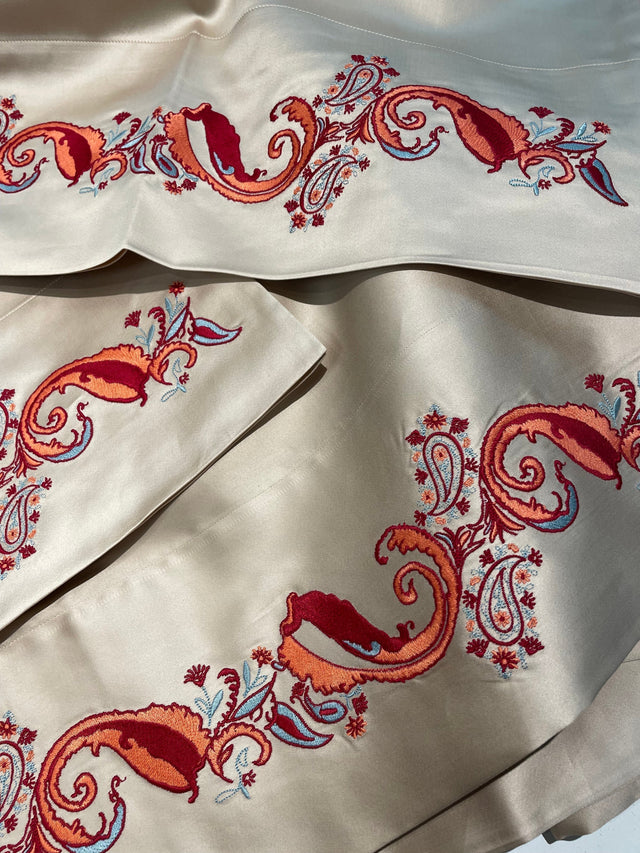

A finished Kearsley piece is the part people see. A duvet with hand embroidery, a cashmere blanket built up in appliqué, a complete set of linens custom fitted to a single bed. The object is the evidence of the work. It is not where the work begins.
The work begins with knowledge, and knowledge is the part of a commission that never appears in a photograph.
The Work Before the Work
Before a yard of fabric is allocated, someone has to know whether that fabric can do what the client wants. Whether there is enough of it from a single dye lot to finish the order. How it will drape, how to best engineer the cuts, what direction the fabric can run, how it will shrink, how warm it will sleep. Whether an embroidery can be scaled without losing its proportion, whether a seam can be avoided, whether a construction will survive decades of use and laundering.
The answers can sound simple once they are spoken. They are not simple to arrive at. They come from nearly thirty years of my own work, from a lifetime of training with my mother, who trained a lifetime with hers, from mill relationships built over years, from factory visits, from thousands of finished pieces, and from the mistakes that taught us what not to repeat.
For a small atelier, that knowledge is not abstract. The phone calls, emails, and texts happen. The drawings are made. The sourcing requests and stock confirmations go to the mills. Loom availability is checked, and the right craftspeople are lined up against what each project needs and what they already have in hand. The specifications are written and the yields are calculated. All of this design work happens before a project is confirmed, and it happens whether or not the project moves forward. Behind it sit payroll, rent, insurance, equipment, travel, and the craftspeople and suppliers who make the work possible.
A client expects to pay an architect for drawings, an interior designer for their hours, an attorney for counsel, an accountant for analysis. The expertise that engineers a bespoke commission is the same kind of professional work, and it carries the same kind of value. The only difference is that ours has often been given away, on the assumption that it is a courtesy extended in the hope of a sale. If that continues, ateliers like ours will not be able to sustain this level of work and stay in business, and the craft itself becomes harder to find.

Shopping and Commissioning Are Not the Same
Part of what we do is retail. We offer stock items and set collections you can purchase directly, made to order in their standard form, with no custom design work required. If a piece from our collections suits your bed and your room as it stands, you can buy it the way you would buy any finished object, and there is nothing further to engineer. Our collections are available to shop directly at KearsleyHome.com or let us know what sort of linens you would like of our fabrics that are rrom our stock fabrics and standard sizing. We are working to add more for ease for all. Still made to order and easier to select.
A bespoke commission is different, and the difference is what the retail comparison misses. It is often measured against a shelf price, and the comparison does not hold, because the two have almost nothing in common. A retailer sells a finished object that already exists in some quantity or is not specifically designed for the clients needs, made before anyone asked for it, at a price that reflects a product that is already complete.
A bespoke Kearsley piece does not exist until it is engineered and made for a specific client, a specific bed, a specific room, a specific location. We work primarily from our own library of fabrics, woven for us in Italy and across Europe, and those fabrics remain part of the piece even when a commission uses a client's own material, what the trade calls COM. We take on COM only on rare occasions, for instance to accommodate a specific quality of cashmere we do not make ourselves. The construction, the fill, the dimensions, and the finishing are all ours. There is no shelf to shop from and no identical version to find for less, because the thing being made does not exist anywhere else. Explore bespoke commissions.
To weigh a bespoke commission against a retail offering is to compare apples and oranges. One is a product that already exists. The other is the engineering and the making of something built to last for generations and suit your specific needs. The fabric is part of it. The expertise is what turns that fabric into the finished functional beautiful piece.

How We Structure It
We have built our process so that this work is recognized for what it is.
Every commission begins with a conversation, and the initial 30 minutes is complimentary. Book a consultation. We collect a list of specifics, and from there, design, engineering, sourcing, communication, and specification are billed against a design retainer set to the scope of your project.
It is the same relationship you already have with your interior designer, architect, or landscaper, only for your table linens, bath linens, special gifts, and the pieces you live with most intimately in your whole home: your bedding. Bedding is too often left as an afterthought, chosen at the end of a project when the budget is wearing thin. It is vital, and it deserves more careful consideration than much of what a project tends to focus on.
If the design work comes in under the retainer, the unused balance is credited toward your order.
The retainer covers the design stage. Production is priced separately and begins only once the quote is approved, and the invoice and paid (serving as signature of approval).
For trade partners, that time is invoiced at a trade rate and passed through to your client as a billable line, the same as any specialized resource, with itemized documentation to support it.
This is not a barrier. It is the structure that allows the expertise to exist at all.

What It Protects
The engineering done in the design stage is what determines everything that follows: the fiber weight, the fill specification, the cutting layout, the dimension that has to be exact. A single decision made well at the start is what keeps a precious material from being wasted and a finished piece from carrying a flaw. The investment in that stage protects the far larger investment behind the commission itself.
It comes from work built across the full range of this field. We have consulted on retail linen programs for luxury properties, designed linens for yachts and private aircraft, created collections for other brands and advised them on merchandising strategy worldwide, and outfitted hotels, down to a single custom set of sheets for a private home. The work has taken us from Monaco to Hong Kong. In each case we learn quickly how a property or vessel actually functions and how the linens will really be used, not only how they should look and feel, but what the laundering systems are, and from there we advise strictly on care. That kind of judgment is not quoted from a shelf. It is built over decades, and it is already rare.
Which is why it protects something larger than any one commission. When expertise is repeatedly given away, the companies capable of providing it begin to disappear, and the skills disappear with them. Paying for it is not only fair to the people who hold it. It is what keeps it available to the next client, and the one after that.
The finished piece is what people see. The expertise behind it is what makes the piece possible.
Sweet Dreams,
Heather Kearsley Wolf
Find similar articles:
#InteriorDesign #LuxuryLinens #HomeDecor #YachtLife #HouseManager #Housekeeping #LuxuryHomes #HomeComfort #ThreadCount #BreathableFabric #Softness #LinenQuality #DesignerLinens #HomeMaking #KearsleyHome. #ethicalluxury #beddingexpert #hotellinens #sheets #Interiordesignerlinens Bespoke Bespoke Linens bespoke vs retail Couture craftsmanship Custom Custom bed linens Custom Bedding Expert Design fine craftsmanship Heirloom Linens kearsley Luxury LInens private wealth management sustainable luxury linensMore stories